The Evidence
What the research actually says — and what it doesn't.
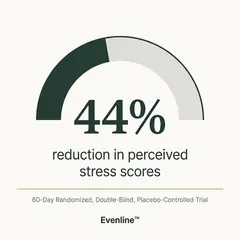
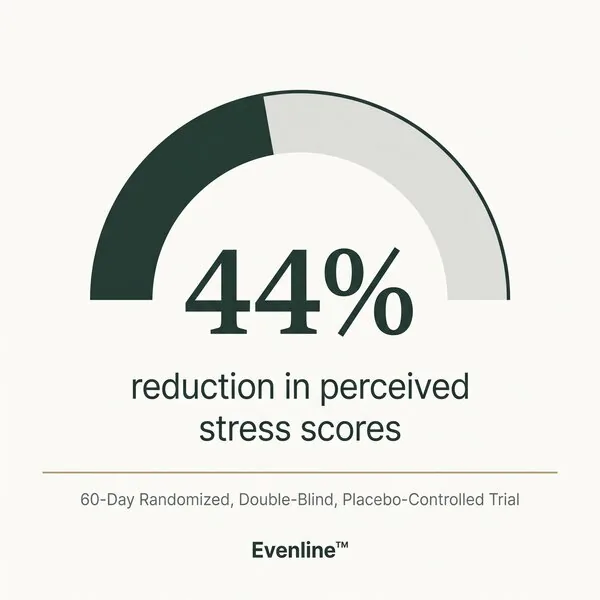
The clinical evidence for ashwagandha is genuine and substantial. A 60-day randomized, double-blind, placebo-controlled trial documented a 44% reduction in Perceived Stress Scale (PSS) scores for the ashwagandha group, compared to 5.5% for placebo. Parallel research demonstrates improvements in sleep latency, sleep quality scores, and morning cortisol levels across comparable timeframes.
What the research also shows — and what most brands don't mention — is that the mechanisms underlying ashwagandha's effects (specifically its GABAergic activity and serotonin receptor interactions) appear to be dose-dependent. This is consistent with the consumer reports describing emotional blunting from sustained high-dose extract use. The phenomenon has a mechanistically plausible explanation in the research literature.
Evenline was formulated with this context in mind: not as a high-dose therapeutic intervention, but as a gentle, consistent, daily botanical support — aligned with how this herb has been used in its country of origin for thousands of years, before the supplement industry turned it into a concentrated extract.
* These statements have not been evaluated by the FDA. Evenline is not intended to diagnose, treat, cure, or prevent any disease.
The Formula
Two ingredients. Both with a reason to be there.
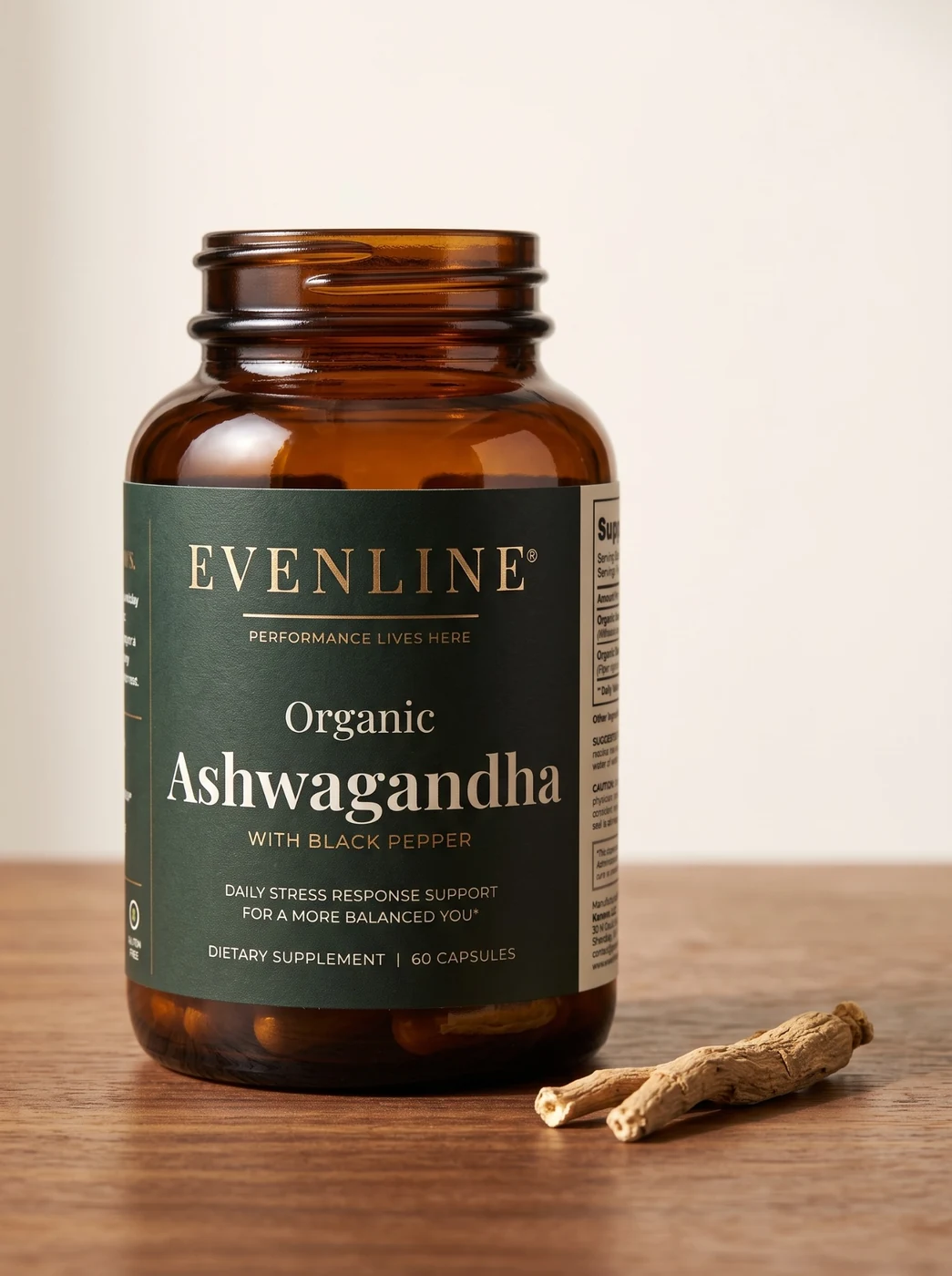
Evenline contains exactly two active ingredients. Not two among twelve — two, total. Every line on the label is visible, explained, and present because it belongs there.
Ingredient 01
Organic Ashwagandha Root
Withania somnifera — the adaptogenic root with over three thousand years of traditional use in Ayurvedic medicine. Evenline uses the whole root in organic form, not a concentrated extract standardized for withanolide percentage. Whole root preserves the full botanical profile the herb was used for historically, without the aggressive extraction that concentrates specific compounds to pharmaceutical-level doses. USDA Organic certified. Third-party tested for identity, potency, heavy metals, and microbial contaminants.
Ingredient 02
Organic Black Pepper
Piper nigrum — the Ayurvedic bio-enhancer that has accompanied ashwagandha in traditional preparations for millennia. In classical Ayurveda, dense botanical roots were paired with Trikatu (black pepper, long pepper, and ginger) to stoke Agni — the digestive fire — and maximize assimilation of accompanying herbs. Piperine, the active constituent, inhibits key metabolic enzymes in the liver and intestinal wall, supporting the absorption of botanical compounds. USDA Organic certified.
Supplement Facts
Serving Size: 1 Capsule
Servings Per Container: 60
Organic Ashwagandha
(Withania somnifera) (root)650 mg **
Organic Black Pepper
(Piper nigrum) (fruit)5 mg **
** Daily Value (DV) not established.
Other Ingredients: Pullulan capsules.
The Mechanism
How Evenline interrupts The Workday Carryover Loop™ — without switching anything off.
The key distinction between an adaptogen and a pharmacological intervention is the direction of action. A sedative suppresses the central nervous system directly — it forces quietude from outside. Melatonin replaces an endogenous hormonal signal with an exogenous one. Both work acutely. Both impose a state rather than support a natural process.
Ashwagandha as an adaptogen appears to operate differently. Current research suggests it modulates the GABAergic system — the primary inhibitory signaling network your brain uses to naturally downregulate neural activity — and interacts with serotonin receptor pathways involved in mood and stress regulation. Rather than overriding these systems, it appears to support their natural regulatory function, helping the nervous system complete the downregulation process it would undertake on its own under less stressful conditions.
In practical terms: the process that allows you to genuinely leave work behind — that shift from operational mode to present mode — exists in your nervous system already. Evenline is designed to support that process, not replace it. The goal is not pharmaceutical quiet. It is the quiet that belongs to you at the end of a demanding day.
How to Take It
Two capsules daily — one in the morning, one in the evening. That's the entire protocol.
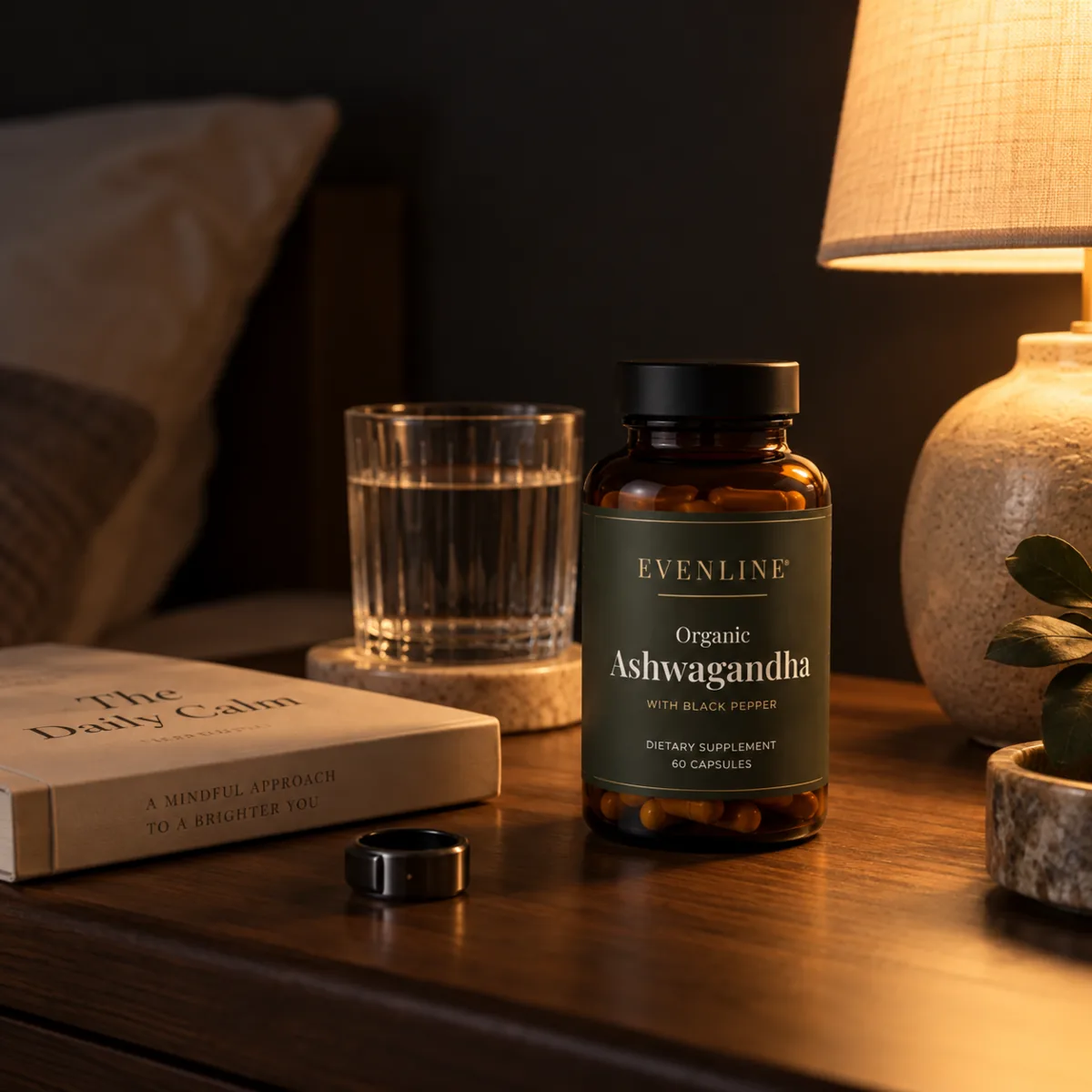
Evenline is designed to be the opposite of a complicated wellness routine. Take one capsule in the morning and one in the evening, each with a glass of water. The morning dose builds the botanical foundation through the day. The evening dose is the daily signal — the consistent cue that tells your nervous system the operational day is closing. Follow the directions on the product label.
Consistency matters. The research on ashwagandha's benefits accumulates over regular use across weeks, not from a single dose. Keep the routine simple and follow the label directions consistently.
This is The Whole-Root Resilience Ritual™ — two capsules daily. One in the morning to support the day. One in the evening to close it.
Always follow the directions on the product label. Consult a qualified healthcare professional before use if you are pregnant, nursing, taking prescription medications, or managing a pre-existing medical condition.
Who This Is For
If you recognize yourself in any of the following, Evenline was built for you.
If you check emails at the dinner table — not because you want to, but because the mental tab refuses to close — Evenline was made for that specific experience. If your family receives the depleted version of you at 7 PM while the office received the best version from 7 AM, Evenline was made for that gap.
The professionals who find it most useful are typically management consultants, corporate attorneys, investment bankers and finance executives, technology leaders, founders, and physicians — roles characterized by high cognitive load, stakeholder accountability, often heavy travel, and the persistent inability to find a clean edge between work mode and everything else. The unifying trait is not profession. It is the burden of operating at the limit of bandwidth for extended periods, and the private cost of never being able to fully disengage.
The Honest Comparison
Evenline versus the alternatives. Including the other ashwagandha products.
Every approach to managing the post-work mental load has a trade-off. Most brands won't show you this table.
|
Evenline
(Whole Root) |
High-Dose
Extracts |
Melatonin |
Alcohol |
| Supports evening transition |
✓ Yes |
✓ Yes |
✗ No |
⚡ 90 minutes |
| Maintains drive and emotional range |
✓ Yes |
⚡ Varies |
✓ Yes |
✗ No |
| Supports restful sleep |
✓ Yes |
✓ Yes |
⚡ Onset only |
✗ Suppresses REM |
| No next-morning effect |
✓ None |
✓ None |
✗ Grogginess |
✗ Fragmented sleep |
| Safe for daily long-term use |
✓ Yes |
⚡ Cycling advised |
⚡ Contested |
✗ No |
| Transparent formula |
✓ 2 ingredients |
✗ Often proprietary |
✓ Yes |
✓ Yes |
| USDA Organic certified |
✓ Yes |
✗ Rarely |
✗ N/A |
✗ N/A |
⚡ = variable or conditional · Forum-reported anhedonia experiences with high-dose extracts are consumer reports, not universally established clinical outcomes. Individual responses to any supplement vary.
Formulation Philosophy
Why black pepper. And why it was always in this formula.
Before the modern supplement industry existed, Ayurvedic practitioners had already solved a problem that pharmacokinetics would later confirm: dense botanical roots are not easily absorbed by the body alone. They require a catalyst — something to cross the digestive barrier and enter circulation effectively.
The classical solution was Trikatu — a blend of three warming spices (black pepper, long pepper, and ginger) used specifically to stoke Agni, the digestive fire, and maximize assimilation of accompanying herbs. Black pepper was not an afterthought. It was the reason the preparations worked.
Piperine, the primary active compound in black pepper, inhibits cytochrome P450 enzymes and P-glycoprotein transporters in the liver and intestinal wall — the mechanisms responsible for metabolizing many botanical compounds before they reach systemic circulation. It is the same mechanism behind piperine's extensively documented effect on curcumin bioavailability. Evenline does not claim a specific ashwagandha absorption percentage, because peer-reviewed human pharmacokinetic data for that exact claim does not yet exist at these doses. What the formula reflects is a formulation philosophy with three thousand years of empirical backing and a mechanistically plausible modern rationale. Black pepper is not a marketing ingredient.
What to Expect
A realistic timeline. No miracles promised.
Ashwagandha is not an acute intervention. The research on its benefits accumulates over consistent daily use across weeks — which is why honest expectation-setting here is not hedging; it's part of how this product actually works.
Weeks 1–2
Most people notice nothing dramatic. The compound builds in the system. Some report marginally deeper sleep on heavy days, or a slight reduction in the wired-but-tired sensation. Others notice nothing at all. Both are normal.
Weeks 3–4
The shift tends to be situational rather than chemical in feeling — a difficult week navigated without the usual residue, a Sunday evening that carries less weight. Often recognized in retrospect: "I realized I didn't check my phone at dinner this week."
Weeks 5–8
Consistent users typically have a clear and honest read on whether the pattern has changed. Sleep quality, evening composure, and the speed at which the day's tension releases are the meaningful markers — not a single dramatic moment.
The guarantee is 60 days for this exact reason. If you haven't given Evenline 60 days of consistent daily use, you haven't given it — or yourself — a fair assessment.
Your Roadmap
Three things that make the difference between noticing and not.
1
Take both doses at the same times each day
Morning and evening, at the same times each day. The evening dose in particular reinforces the behavioral signal — the moment the workday ends — alongside the biochemical support. Consistency of timing across weeks matters more than perfect precision on any single day.
2
Give it 60 days before making a verdict
The temptation is to assess after a week. Weeks 1–2 are the build phase. The meaningful data about whether Evenline is changing your pattern will be in weeks 3–8. The 60-day guarantee exists precisely so you can make this assessment risk-free.
3
Track the small moments, not the dramatic ones
The change you're looking for is not a pharmaceutical transformation. It's the realization — often retroactive — that you cooked dinner without opening your phone, or that Monday morning didn't arrive in your chest on Sunday afternoon. The small specific moments are the real markers.
More Questions
The things people actually want answered before putting something in their body.
Is ashwagandha safe for daily long-term use?
Current safety data supports daily use of ashwagandha for up to 12 weeks in healthy adults. Research on longer durations is ongoing. Evenline recommends beginning with a 90-day supply — consistent with the clinical research timeline — and reassessing based on your individual experience. Consult a qualified healthcare professional before starting, particularly if managing any medical condition or taking prescription medications.
Can I take this with my existing medications?
Ashwagandha and piperine (from black pepper) can interact with certain medications. Piperine inhibits drug-metabolizing enzymes, which can affect how your body processes specific drugs including some blood thinners, anticonvulsants, and cardiovascular medications. Ashwagandha may have additive effects with sedatives and thyroid medications. Always consult your prescribing physician or pharmacist before adding Evenline to your routine if you take any prescription medications.
I have a thyroid condition. Can I take Evenline?
Ashwagandha has been associated with effects on thyroid hormone levels in some research, and may interact with thyroid medications including levothyroxine. If you have a thyroid condition or are taking thyroid medication, consult your endocrinologist or physician before using Evenline. This is a genuine precaution, not boilerplate.
Is this product third-party tested for heavy metals?
Yes. Evenline is third-party tested for identity, potency, heavy metals, and microbial contaminants. Heavy metal testing is non-negotiable for any supplement using ingredients sourced from South Asia. A Certificate of Analysis is available on request. Reach out through the contact page and we'll send the complete test results within 24 hours — the full report, not a summary.
Can I take Evenline if I'm pregnant or breastfeeding?
No. Ashwagandha is not recommended during pregnancy or breastfeeding. The NIH's Office of Dietary Supplements specifically advises against use during pregnancy. This is a firm contraindication, not a precautionary footnote.
How does Auto-Ship & Save work?
Auto-Ship keeps your supply on schedule so you do not have to remember to reorder, and you save 15% on every delivery: 1 bottle every month, 2 bottles every 2 months, or 3 bottles every 3 months. Skip, pause, or cancel before your next renewal. The same 60-Day Satisfaction Guarantee applies from your first delivery.